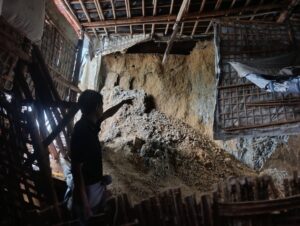
A Rohingya refugee points to the landslide that killed two of Abdu Rozork’s daughters and two of their children in their bamboo shelter in a refugee camp in Cox’s Bazar, Bangladesh, last month.
Credit: Mohammed Zonaid/IPS
By Mohammed Zonaid
COX’S BAZAR, Bangladesh, Aug 6 2026 – Abdu Rozork awoke suddenly to the sound of children screaming. Heavy monsoon rains had sent a landslide barrelling into the section of their bamboo shelter where the women and children were sleeping.
Neighbours rushed to help dig through the mud with their bare hands, but it was too late. Two of Rozork’s daughters and two grandchildren were killed.
Having fled war in Myanmar only two years earlier, Rozork had believed his family would finally find safety among the over one million Rohingya refugees living in densely packed camps in Cox’s Bazar, southeast Bangladesh.
“I escaped conflict in Rakhine State to save my family,” he told IPS. “But I could not save them here.”
Early waves of Muslim minority Rohingya fleeing violence and persecution in Myanmar were housed in the first large-scale camps set up in Cox’s Bazar in the early 1990s. In 2017 a devastating crackdown by the Myanmar military against the Rohingya community and militants in Rakhine State forced another mass exodus, this time of over 700,000 refugees, creating the world’s largest refugee settlement.
Since 2024 and the disintegration of Myanmar amidst civil war, these overcrowded camps have been joined by further waves of civilians fleeing a complex conflict between the junta and the Arakan Army (AA), an ethno-nationalist insurgent group that has seized control over much of Rakhine State, as well as the involvement of Rohingya militants. According to data released by UNHCR, by June those new arrivals in Cox’s Bazar numbered 153,640.
But no new land has been allocated to this recent wave of refugees for building shelters. Many families now have to share with relatives or build makeshift homes on steep hillsides vulnerable to landslides and flooding. Cutbacks in international funding have also led to cuts in classes for children and reduced food rations.
Days of heavy rain since early July triggered landslides and flooding in several of the camps, killing at least 17 people and displacing more than 3,000, according to Human Rights Watch.
Rozork said he had repeatedly asked humanitarian agencies for help with tarpaulins and to make a retaining wall. His bamboo shelter stood at the foot of a hill, and rainwater was coming in.
But organisations responsible for site management told him assistance was unavailable because his family had only recently arrived in Bangladesh. “No one warned us that the shelter was in a dangerous place,” he said. Days later the mud swept down.
His family’s tragedy is one of many among the newest Rohingya arrivals who escaped one crisis only to enter another.
Mohammed Kayes, now 13, was attending school in Buthidaung Township in northern Rakhine when fighting intensified between the Myanmar military and the AA, spreading towards his village. Schools closed, food became scarce, and medical services disappeared.
His family fled through forests and villages for seven days before reaching the Bangladesh border. During the journey, Kayes said Arakan Army members detained his family. After several days, they released them but later took his father away for what they described as questioning. He never returned.
After finally reaching Bangladesh, tragedy struck again. His mother, suffering from a stomach tumour, died after months of illness despite efforts to obtain treatment.
Kayes now helps care for his younger siblings while living with his grandmother. He receives food rations, but with the loss of his mother, they do not qualify for gas cylinders to cook.
His dream is to become a teacher. “I want to study,” he told IPS. “I want to build my future.”
Sawfowan’s dream is to work for the United Nations, but conflict also engulfed his village in Buthidaung, closing schools. “We heard gunfire almost every day,” the 17-year-old said. The men in the family had to flee over a year ago to avoid forced conscription by the AA.
His family struggled to obtain medicine for his diabetic mother, so in May they also decided to flee. According to Sawfowan, Bangladesh border authorities twice pushed the family back across the frontier, but they managed to enter on a third attempt and reunite with relatives inside the camps. Several families now share a single bamboo and tarpaulin shelter.
“I feel safer here,” he said. “But life is still very difficult.”
Community leaders say such experiences are increasingly common among the newest arrivals.
Mohammed Musa, a Rohingya youth leader, said families consistently report forced displacement, disappearances, movement restrictions and food shortages in Rakhine.
“Many arrive carrying deep trauma after losing relatives or surviving repeated displacement inside Myanmar,” he said. “But once they reach Bangladesh, they face another struggle.”
UNHCR says newly arrived refugees receive food assistance, cooking gas, core relief items and protection services under existing government approvals. However, the agency acknowledges that the absence of new land and severe funding shortages have limited humanitarian efforts to relocate families to safer areas or improve shelter conditions.
“The recent loss of lives due to the heavy monsoon rains is a tragic reminder of how vulnerable the camps remain,” Shari Nijman, UNHCR Bangladesh Communications Officer, said.
As conflict continues in Myanmar, Bangladeshi authorities say Rohingya are crossing the border every week despite tighter controls.
The Arakan Army now controls most of Rakhine State but the capital, Sittwe, and has driven Rohingya from their homes. Survivors and rights groups have documented allegations of forced recruitment and mass killings of Rohingya in the village of Hoyyar Siri by the Arakan Army in May 2024, as well as drone attacks on people gathering on the border, burning of villages, arbitrary arrests, and other abuses. The AA denies it carried out the Hoyyar Siri massacre.
Myanmar military airstrikes also continue to displace civilians across the state.
Rohingya fleeing the violence have also been pushed back at the Bangladesh border, while hundreds have died attempting dangerous sea crossings and falling victim to traffickers.
As in many conflicts worldwide, Bangladesh and the international community are faced with a complex crisis where divisions between refugees and combatants become blurred.
Despite the risks, the exodus has not stopped. “Our reports suggest that every week 50 to 60 new Rohingya are entering Bangladesh,” Refugee Relief and Repatriation Commissioner Mizanur Rahman told The Daily Star in July.
IPS UN Bureau Report
!function(d,s,id){var js,fjs=d.getElementsByTagName(s)[0],p=/^http:/.test(d.location)?’http’:’https’;if(!d.getElementById(id)){js=d.createElement(s);js.id=id;js.src=p+’://platform.twitter.com/widgets.js’;fjs.parentNode.insertBefore(js,fjs);}}(document, ‘script’, ‘twitter-wjs’);



 Saudi Riyal Exchange Rate